

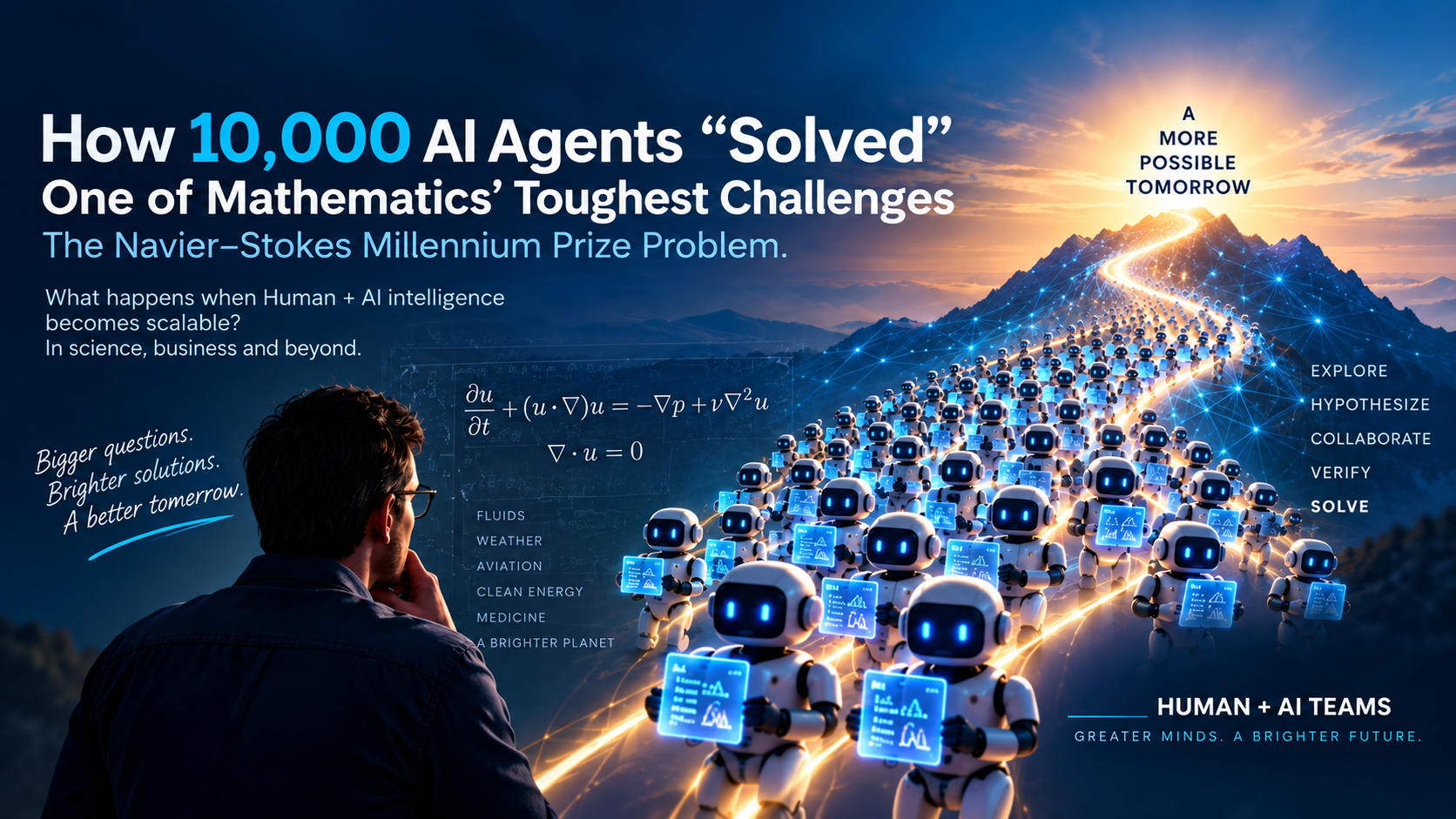
For almost 90 years, some of the world's greatest mathematical minds couldn't solve this problem. Then thousands of AI agents went to work.
And that raises a much bigger question: what happens when intelligence becomes scalable?
For centuries, one of humanity's greatest constraints has been the availability of brilliant minds — and the amount of time those minds have. A brilliant mathematician still has only 24 hours in a day. A manager can coordinate only so many people. AI agents could fundamentally change this equation.
The Navier–Stokes equations describe how fluids move — from air flowing around an aircraft to water, weather systems and blood flow. A fundamental question about these equations had remained unresolved for roughly 90 years and became one of the famous Millennium Prize Problems.
In September 2026, OpenAI announced that its AI system had produced a proposed solution. But what fascinates me even more than the mathematics is how the problem was attacked.
Around 10,000 AI agents were working concurrently on the problem. Different groups explored different approaches, generated hypotheses, challenged ideas and built on one another's work. The agents exchanged approximately 2.7 million messages. Roughly 88 hours after the first agents were launched, they had arrived at the proposed solution.
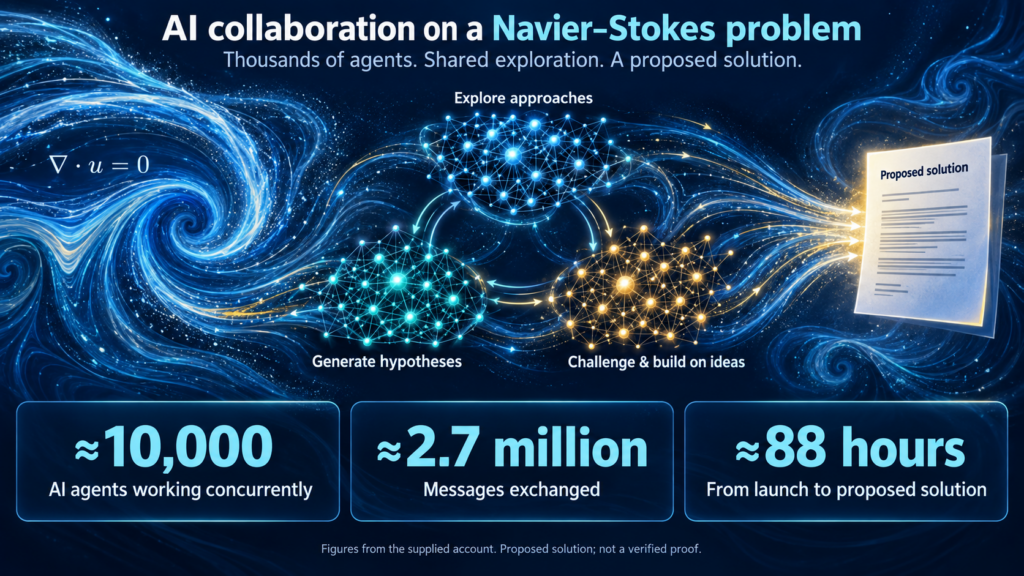 The result still needs the scrutiny expected of a mathematical breakthrough of this magnitude. But the way the problem was approached already gives us a glimpse of something potentially transformative: we are beginning to scale intelligence itself.
Imagine having not one AI assistant but 10, 100 or 10,000 specialized AI agents working simultaneously. One searches. Another calculates. Another develops hypotheses. Another challenges them. Another integrates the findings. Another verifies the result. And they can do all of this in parallel.
Suddenly, the scarce resource may no longer be access to intelligence. The scarce resource becomes our ability to direct, coordinate and orchestrate intelligence effectively.
From Managing People to Orchestrating Human + AI Teams
This has enormous implications for business and leadership. For decades, management has largely been about organizing scarce human capacity: who should do what, where we allocate our best people, which projects deserve limited resources, how we coordinate specialists.
Those questions aren't disappearing. But now we need to answer new ones: Which tasks should humans perform and which should we delegate to AI agents? How many agents should we deploy? How should they collaborate and challenge one another? When should humans intervene? And who remains accountable for the result?
The Navier–Stokes project gives us an early glimpse of this new operating model. The humans didn't disappear. Humans selected the problem, allocated resources, recognized promising results and redirected agents toward the most promising paths — and humans remained responsible for evaluating what emerged.
That is precisely why I believe the future isn't Human OR AI. It is Human + AI.
Leaders as Managers of Infinite Minds
Imagine a project leader who today manages 20 people. Tomorrow, those same 20 people might each orchestrate dozens or hundreds of specialized AI agents. The intellectual capacity available to that team could increase dramatically without increasing the human organization at anything close to the same rate.
This changes the role of leadership. But there is an important catch: giving a poor manager 1,000 employees doesn't make them 1,000 times more productive — it multiplies the management problem. The same will be true for AI agents.
If we cannot define objectives clearly, provide the right context, establish constraints, divide work intelligently, coordinate agents and validate their outputs, additional AI capacity may simply generate additional noise. That's why I believe AI delegation and orchestration will become core leadership skills.
The leader's role starts moving upward: from doing to delegating, from prompting to orchestrating, from producing answers to defining the right questions, from managing tasks to designing Human + AI systems.

Tomorrow's leaders may increasingly become Managers of Infinite Minds — humans capable of orchestrating enormous amounts of digital intelligence while providing the purpose, judgment, creativity and accountability that remain uniquely human.
So perhaps the most important question for leaders is no longer "What can AI do for me?" but
"What could my team achieve if intelligence were no longer our limiting factor?"
That is the promise of Human + AI Teams. And we are only beginning to discover what they can achieve.
I'd love to hear from you: if you could deploy 100 AI agents on your team's biggest challenge tomorrow, what would you point them at? Drop your answer below.
