

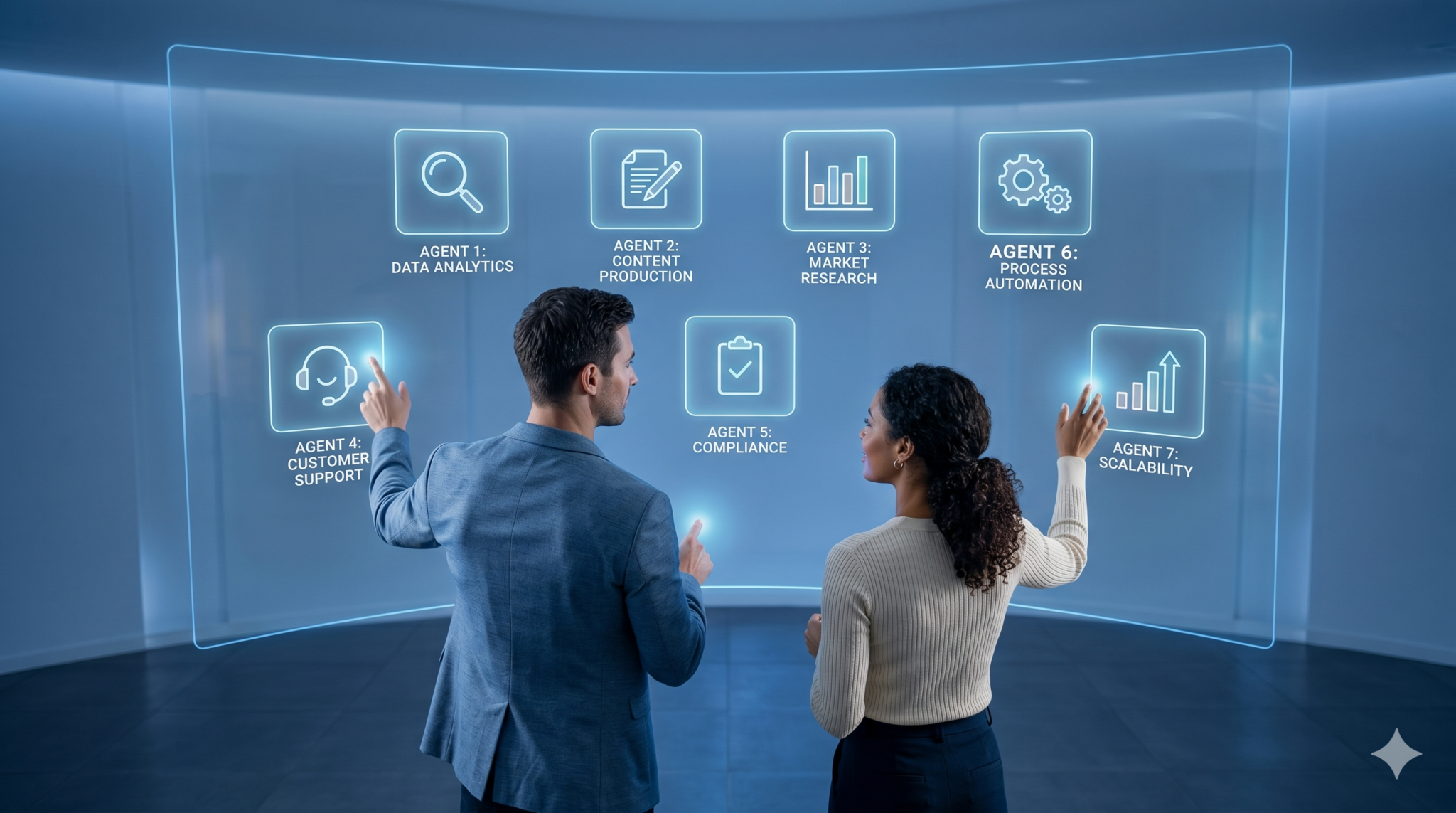
We worked with a large environmental and recycling company whose core business depended on winning public tenders. Their team of 10 was dedicated, capable — and completely overwhelmed. Endless documents, constant deadlines, high cognitive load. They weren’t inefficient. They had simply hit a ceiling.
The painful truth: they couldn’t scale anymore. More tenders meant more stress, not more results. Hiring wasn’t the answer — too slow, too expensive, and ultimately unsustainable.
So instead of adding more people, we added AI agents.
We designed a system of 7 specialized agents, each doing one job — extremely well:
🧠 Agentic Workflow — Tender Processing System
- Data / Context / Documents Agent → Source materials (tender docs, past bids, company data)
- Eligibility Verification Agent → Checks if the company meets all formal tender requirements (legal, financial, technical criteria) before investing effort.
- Quantification Agent →Extracts and quantifies key tender requirements (costs, timelines, KPIs, volumes) into structured data.
- Scoring Agent → Evaluates how well the company’s offer matches tender criteria and predicts win probability.
- Proposal Summary Agent → Generates a clear, structured draft of the tender response aligned to requirements and scoring logic.
- Results Aggregation Agent → Combines outputs from all agents into a unified view (scores, risks, costs, recommendation).
- Validation Agent → Reviews the final proposal for compliance, consistency, and error reduction before submission.
Each agent has one clear role — just like a high-performing team. What’s fascinating is that we didn’t replace the organization. We replicated it, digitally.
The impact was immediate:
- 50 % faster tender processing time
- Up to 30% cost reduction in operations
- Higher quality submissions — fewer errors, more consistency
The team didn’t disappear. They moved up — from doing the work to validating, steering, and improving it. From 10 people to 4, supervising a system that outperforms the one before it.
And here’s the part most leaders miss: this is not rocket science. With today’s tools, you can build something like this without writing a single line of code — just by designing the workflow.
The future of work isn’t humans versus AI. It’s humans orchestrating AI teams. The companies who learn this first will scale without burning out the people who make them great.
Want to learn how to design AI agentic systems for your own business?
Join my 2-day online AI for Leaders workshop — we don’t just talk about AI, we build it together.
