

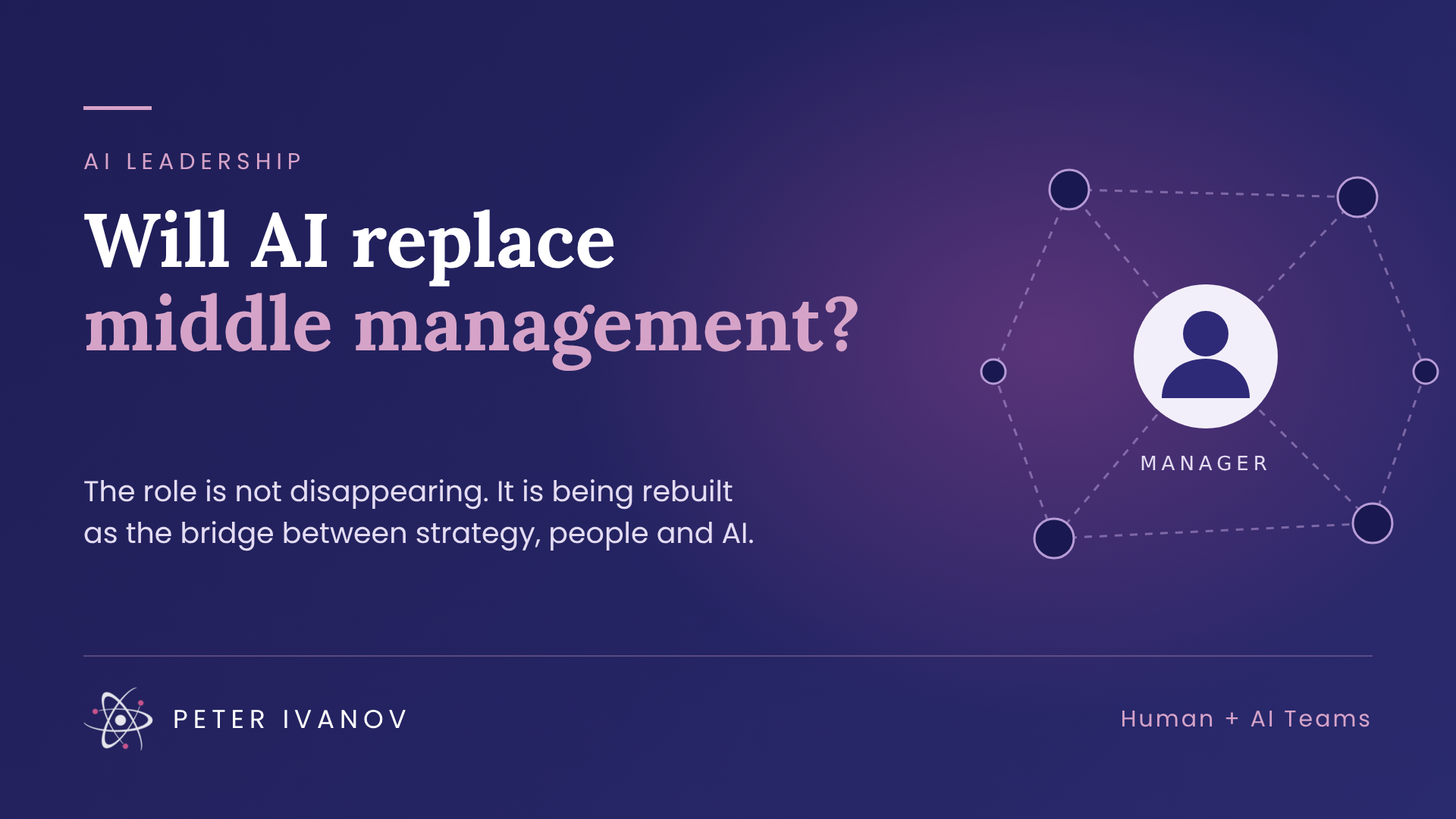
AI will eliminate a large share of coordination work. That does not make middle managers obsolete. It makes weak management easier to expose and strong management more valuable.
Every few weeks, another headline asks whether AI will replace middle management. It is an understandable question. AI can already summarize meetings, draft status reports, analyze performance data, schedule work and prepare executive updates – many tasks that once consumed a manager’s day.
But the evidence points to a more consequential shift. Organizations are flattening. Coordination is being automated. The managers who remain are inheriting wider spans of control and more individual work, while also being asked to guide AI adoption. The role is not disappearing so much as being compressed and redesigned.
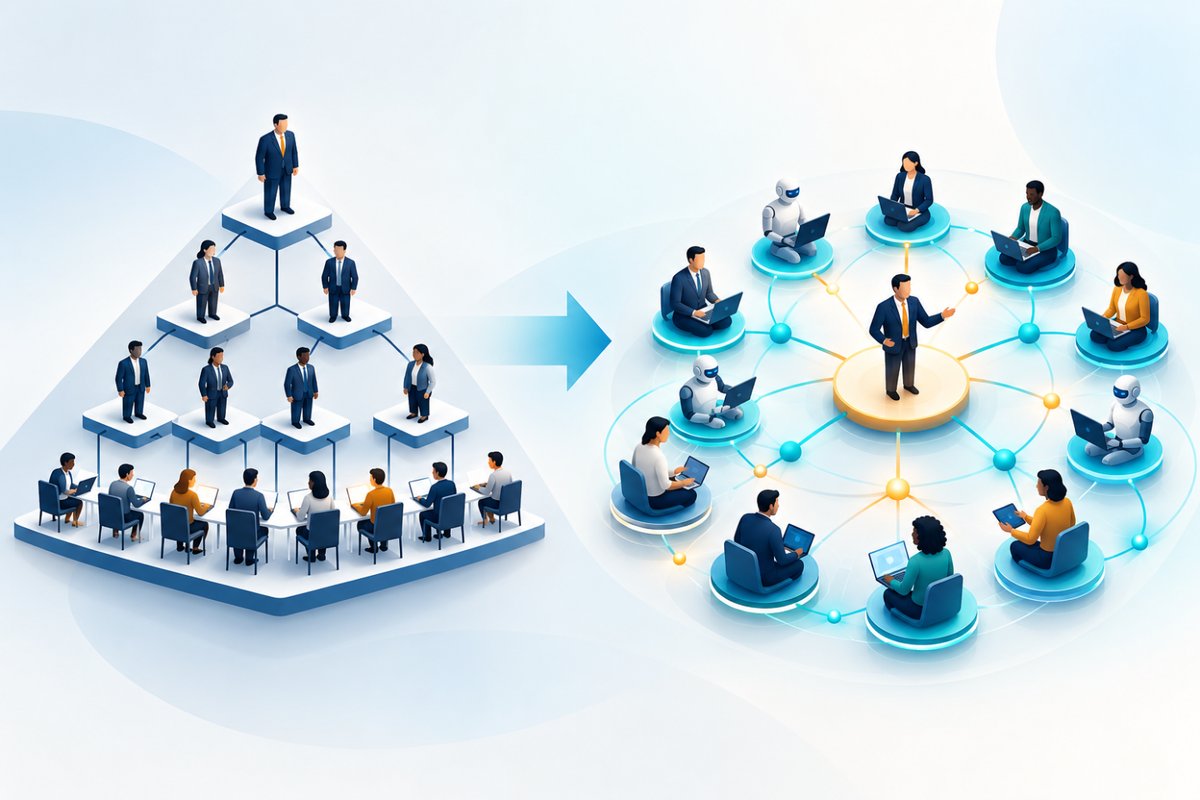
The future does not belong to the manager who mainly carries information up and down the hierarchy. It belongs to the leader who turns strategy into coordinated action, develops people, creates trust and gives both humans and AI agents clear roles, boundaries and accountability.
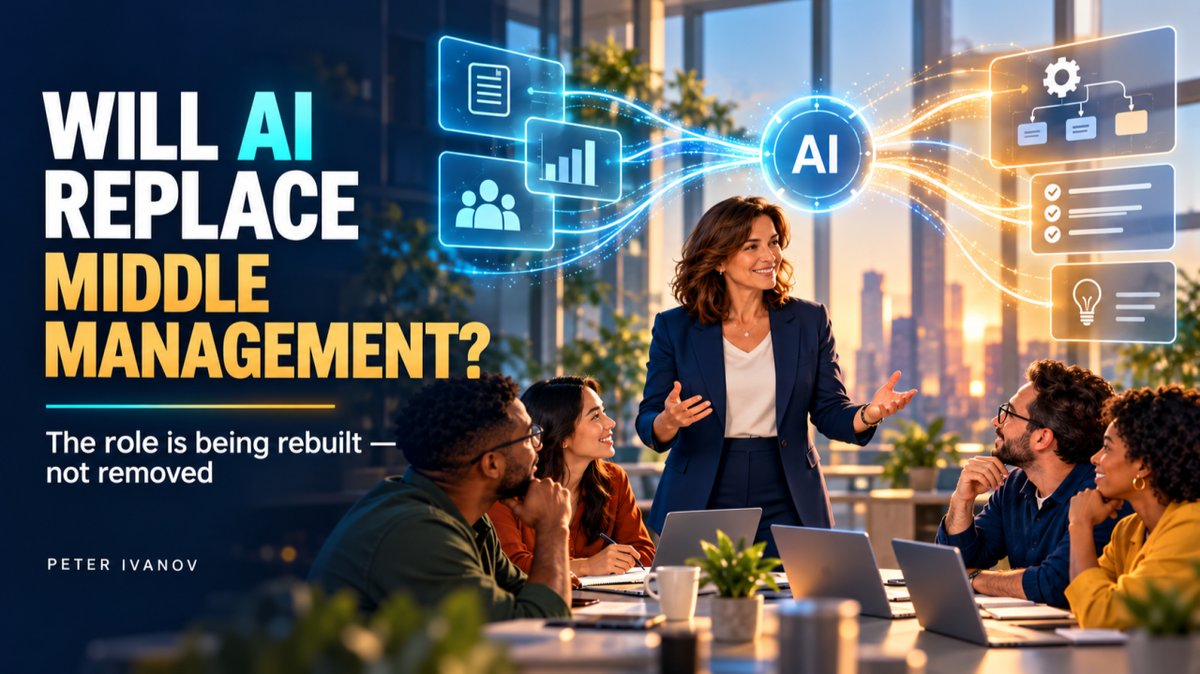
The Great Flattening is real
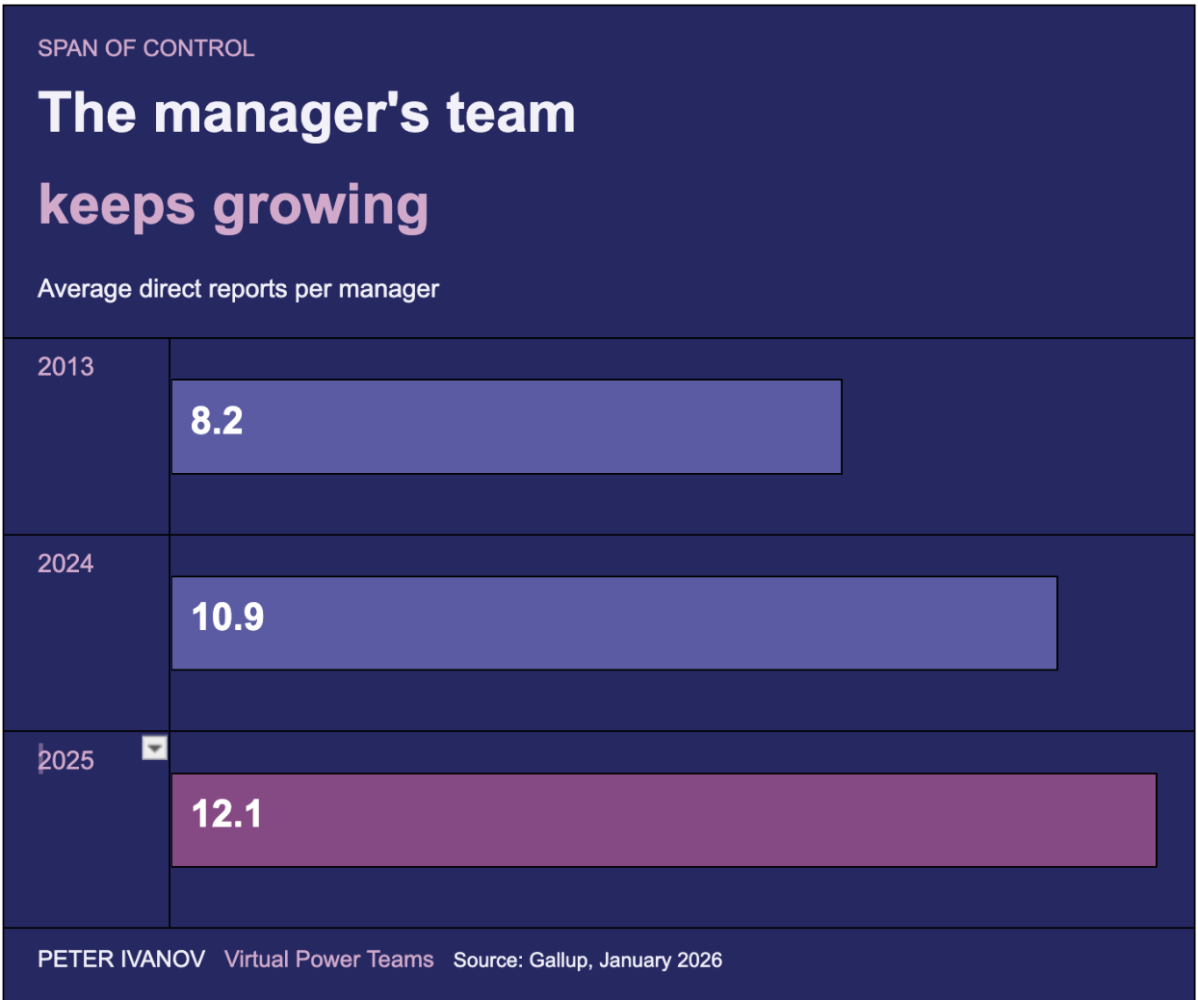
Gallup reports that the average number of people reporting to a U.S. manager rose from 10.9 in 2024 to 12.1 in 2025 – nearly 50% above the level Gallup first measured in 2013. Thirteen percent of managers now oversee 25 or more people. Gallup describes this broader delayering trend as the Great Flattening.
That does not prove AI caused the cuts. Cost pressure, organizational redesign and years of doing more with less all predate generative AI. Yet AI strengthens the business case for removing coordination layers: if leaders can generate analyses and briefings instantly, they may conclude that fewer managers can supervise more work.
The danger is confusing an organizational chart with an operating system. Removing a box is easy. Replacing the judgment, coaching and trust that flowed through that box is not.
The hidden capacity problem
Gallup found that 97% of managers have individual-contributor responsibilities in addition to leading others, consuming a median 40% of their time. When that workload rises above 40%, manager engagement falls further as team size grows.
This is the real risk behind the AI efficiency story. A company automates reports, removes management positions and widens spans of control. But the remaining managers are still expected to deliver their own work, coach more people, interpret change, manage performance and now lead AI adoption. Administrative time may fall while leadership complexity rises.
AI can create capacity only if organizations deliberately reinvest the saved time. If every saved hour is converted into more direct reports, more projects and more reporting, the technology does not free the manager to lead. It simply raises the load.
Managers are the adoption layer
Gallup’s latest workplace research makes the paradox clear. Only 36% of employees in organizations integrating AI strongly agree that their manager actively supports the team’s use of AI. Yet 78% of employees with supportive managers use AI frequently, compared with 44% among employees who do not strongly agree that they receive such support.
The same pattern appears in culture. Employees who strongly agree that their manager champions AI are far more likely to say AI has transformed how work gets done. They are also more likely to report an improvement in workplace culture. At the same time, half of CHROs in Gallup’s roundtable survey are not confident in managers’ ability to guide employees’ AI use.
That is not an argument for eliminating middle management. It is an argument for upgrading it. Strategy becomes behavior only when someone translates it into concrete workflows, standards, permissions, learning and feedback. In most organizations, that person is the manager closest to the work.
| AI can absorb | The human manager must own |
|---|---|
| Drafting reports and summaries | Judgment in ambiguous situations |
| Scheduling and routine coordination | Trust, coaching and difficult conversations |
| Monitoring workflows and exceptions | Priorities, trade-offs and accountability |
| Preparing options from available data | Purpose, ethics and responsible use |
| Executing bounded repeatable tasks | Developing people and future leaders |
The emotional work cannot be automated away
Workers’ concern is rising faster than the evidence of actual displacement. Gallup found that 27% of U.S. workers worry technology could soon make their jobs obsolete, a record high in its trend. Gallup also notes that the overall effect of AI on employment remains modest so far.
The people who use AI most frequently may feel the threat most directly. Across Gallup’s panel data, frequent AI users were more than twice as likely as less-frequent users to fear job elimination. Supportive management materially reduced that anxiety, especially among frequent users.
This is where leadership becomes decisive. People need clarity about which tasks will change, which capabilities will matter, how performance will be evaluated and what development opportunities remain. An algorithm can provide information. It cannot create the sense that a person is respected, seen and worth investing in.

Five ways middle managers become more valuable
1. Move time from coordination to coaching. Use AI to reduce preparation and reporting, then protect the recovered time for one-to-ones, feedback and development. Capacity should become better leadership, not merely a larger workload.
2. Onboard AI like a trusted teammate. Give every agent a purpose, an accountable human owner, data access limits, allowed actions, approval thresholds and a review rhythm. Delegation without governance is not leadership.
3. Redesign work before reducing roles. Separate tasks that AI can automate from decisions that require judgment, context or human trust. Improve the workflow first; redraw the organization only after the new system is proven.
4. Measure the real span of control. Count not only direct reports but also projects, interfaces, time zones, AI agents and individual-contributor obligations. A nominal team of eight can carry the coordination complexity of a team three times that size.
5. Build the next generation of leaders. Do not allow the automation of junior work to erase the learning path into management. Create apprenticeships, stretch assignments and supervised AI-supported work that develops judgment rather than only output.
The role that survives
AI will replace parts of middle management. Status consolidation, routine follow-up, first-draft analysis and basic coordination are already being automated. Some organizations will use those gains to remove layers. Others will use them to give managers the capacity to lead better.
The difference will determine whether flatter organizations become faster or simply more fragile.
My conclusion is not that every management role is safe. It is that the work that matters most is becoming clearer. Managers who act mainly as information relays are exposed. Managers who build trust, develop people, resolve ambiguity and orchestrate humans with AI are becoming the operating system of the new organization.
The future manager will supervise fewer handoffs and more intelligence. The job is moving from controlling activity to designing a Human and AI Team that can deliver power, passion and performance – with accountability remaining unmistakably human.
For leaders and organizations
Peter Ivanov helps managers and executive teams build high-performing Human + AI Teams through keynotes, workshops and advisory programs. Connect with Peter Ivanov on LinkedIn or visit peter-ivanov.com to discuss how to empower your managers and teams through AI.
