

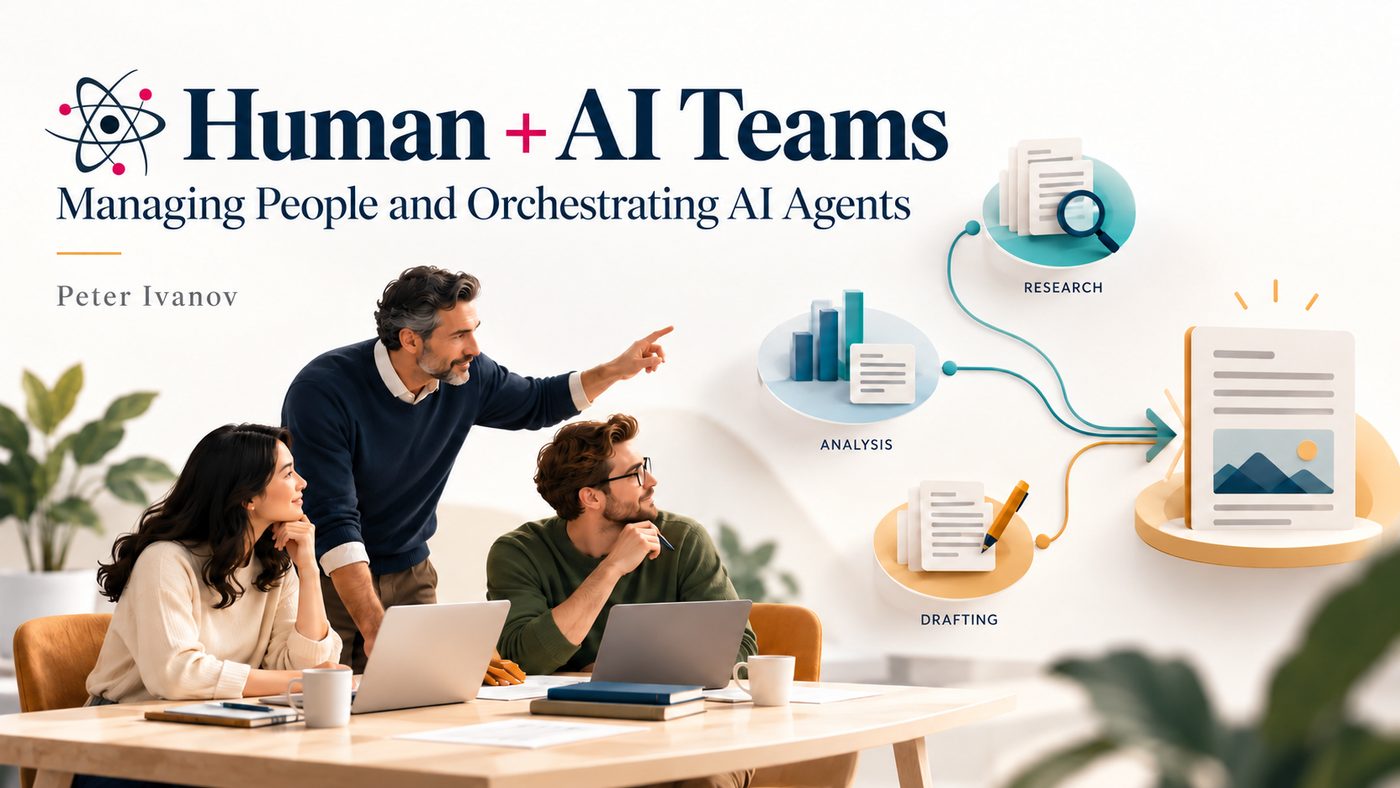
Many people talk about agentic AI, but what does it really mean to have AI agents as trusted team members and to build powerful Human + AI teams? How do you find the right balance between managing people and orchestrating AI agents? Let’s clarify the concept and look at some practical examples.
Orchestrating AI agents means designing, directing and supervising a set of AI workers so they deliver one business outcome together with people. It is closer to running a production line with human supervisors than to "using a tool".
Four terms worth separating
- Assistant: answers when asked. One human, one AI, one prompt at a time. Example: drafting a client email.
- Agent: pursues a goal across several steps, using tools (search, CRM, email, code) with some autonomy. Example: an agent that researches a prospect, fills the CRM record and drafts the first outreach.
- Multi-agent system: several specialised agents, each with a narrow role, passing work to each other. Example: a research agent, a writing agent, a compliance-check agent and a scheduling agent that together produce and send a proposal.
- Orchestrator: the layer that decides who does what, in which order, with which permissions, and when a human must step in. It can be software (a workflow engine) or a human lead, usually both.
What orchestrating actually entails: the five jobs

- Define the outcome and the boundaries. What is the agent for, what may it never touch, and what does "done" look like?
- Split the work. Decide which steps are AI-led, which are human-led and which are shared. Match the task to the strength: AI for volume, speed and pattern; people for judgment, context, relationships and accountability.
- Connect and permission. Give each agent only the data and tools its role needs (least privilege), under its own identity so actions can be traced.
- Supervise. Set checkpoints where a human reviews, approves or overrides. Monitor outputs, cost, errors and drift.
- Improve. Review failures, tighten instructions, retire agents that do not earn their place.
Managing people vs. orchestrating agents

| Aspect | Managing people | Orchestrating AI agents |
|---|---|---|
| Main lever | Motivation, trust, development | Instructions, permissions, checkpoints |
| Typical failure | Misalignment, disengagement | Confident errors, scope creep, silent drift |
| Feedback loop | Conversations, coaching | Logs, evaluations, prompt and rule changes |
| Accountability | The person owns their work | A named human owns every agent's output |
| Scaling | Slow, hiring-led | Fast, which also scales mistakes fast |
Managing people compared with orchestrating AI agents
Practical examples
- Sales team: an agent screens inbound leads and drafts replies. The sales manager approves anything above a set deal size and reviews a weekly sample of the rest.
- Project office: agents compile status reports from tickets and flag schedule risks. The project manager decides what is escalated to the sponsor.
- HR service: an agent answers routine policy questions and pre-fills forms. Anything involving a dispute, health or termination goes straight to an HR partner.
- Insurance claims: one agent extracts data from documents, another checks it against the policy, and a human adjuster signs off on every payout above a threshold.
Example: an insurance policy change
Rules verify the request, an agent makes the change and can hand over to an expert, and only risky cases go to a human before the policy is bound.

Trusted Human + AI teams are not built by buying more tools. They are built by clear roles, smart checkpoints and people who know how to lead both humans and agents.
If you’d like to build your Human + AI teams, redefine your AI-native workflows, and build the skills and motivation to orchestrate AI agents, check out my resources at www.peter-ivanov.com or get in touch at info@peter-ivanov.com.
Next in this series: what goes wrong when AI agents act without guardrails, and how to protect your team.
