

Teams that adopt AI fast often become isolated fast, too.
Gallup’s 2026 State of the Global Workplace report found that leaders and managers now report more daily stress, anger, sadness, and loneliness than the people they lead, even as organizations pour money into AI. The AI isn’t antisocial by design. It quietly removes the small, unplanned moments of human contact that used to hold a team together: the question you asked a colleague instead of a chatbot, the shared frustration over a task that’s now solved alone in twelve seconds. Keeping a team connected in the AI era doesn’t happen by accident. It takes the same deliberate design Peter Ivanov uses with his Virtual Power Teams method, applied to a new problem.
Isolation Was Already the Risk in Virtual Teams. AI Didn’t Cause It, but It Accelerated It
Long before AI, distributed and hybrid teams already had a connection problem: the informal, unscheduled contact that happens naturally in a shared office doesn’t happen on its own when people work apart. That’s the starting premise behind Virtual Power Teams and the 10 Big Rocks, Peter’s method for managing virtual and hybrid teams. AI adds a second layer to the same problem. Even people sitting in the same building, on the same team, can now go most of a workday without needing another human at all, because the AI answered the question, drafted the doc, or ran the analysis instead. The tool changed. The underlying risk — an organization built on individual output instead of shared work — is the same one Peter has been addressing since before AI made it worse.

Two separate 2026 studies back this up from different angles. Gallup’s report, based on more than 141,000 employees across 140-plus countries, found that leaders now carry more daily stress, anger, sadness, and loneliness than the people they manage, even as their overall engagement scores stay higher. And a 2026 survey of 22,481 employees by MyIQ, reported by Forbes, gets specific about the mechanism:
74% of people now ask AI a question they used to ask a colleague.
48% report fewer spontaneous conversations at work, and 53% say their workday feels more transactional than it used to. None of that is a coincidence. It’s the exact isolation risk Virtual Power Teams was built to address, showing up in a new set of numbers.
Leaders Are Now Managing More Than Just Their People
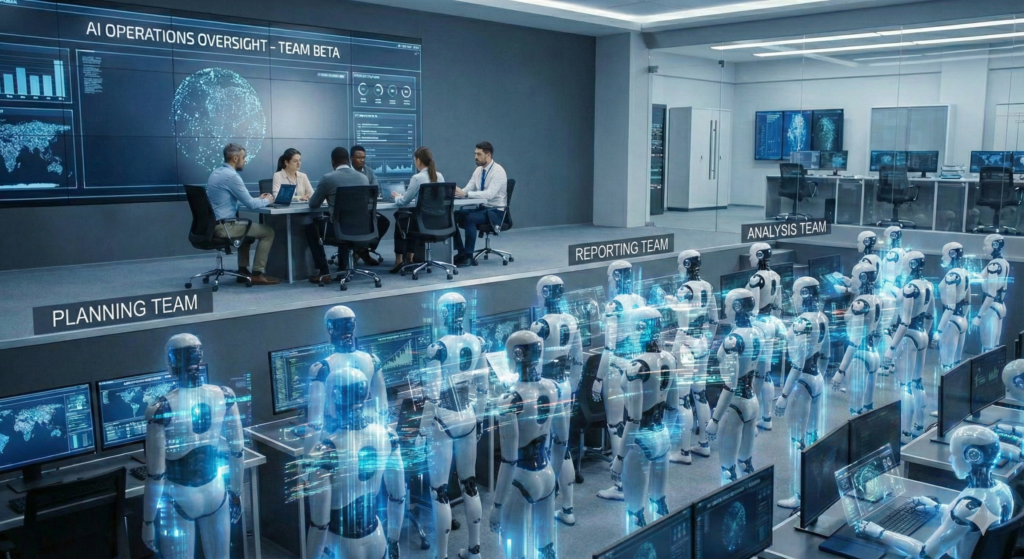
Peter’s talk on Managers of Infinite Minds names something most leaders haven’t fully admitted yet: they aren’t only managing a team of people anymore. They’re managing a team where every person also has one or more AI collaborators working alongside them, each with a different capability, a different failure mode, and no shared context with the rest of the team unless someone deliberately creates it. A manager who only tracks human-to-human dynamics is now missing half the picture. The team’s actual connectedness depends as much on whether people are talking to each other about how they use AI as it does on whether they’re talking to each other at all.
Gallup’s own AI-adoption data makes the stakes concrete: employees whose manager actively supports their AI use are up to 8.7 times more likely to say AI has genuinely transformed how their work gets done. Only around three in ten employees currently say their manager offers that kind of active support. Most managers are absent from exactly the conversation Managers of Infinite Minds says they need to be leading.
Make AI a Team Conversation, Not an Individual Habit
The single biggest lever here: stop treating AI use as something each person figures out alone. When a team member’s AI workflow is invisible to the rest of the team, whatever isolation that creates stays invisible too. The MyIQ data shows what that invisibility costs: 46% of employees say they now know less about how their teammates actually approach problems, and 59% ask colleagues for a second opinion less often than they used to. Peter’s approach with client teams starts by putting AI use on the table as a shared topic: what people are actually using it for, what AI is getting wrong, and what prompt or approach is worth stealing from a teammate instead of reinventing solo. This one shift — treating AI as a trusted teammate the whole team discusses openly, rather than a private tool each person quietly optimizes — does more to rebuild connection than any wellness initiative bolted on afterward.

Redesign the Rituals, Don’t Just Add More Meetings
More meetings is the wrong answer, and most leaders reach for it first. The right move is redesigning the rituals a team already has so they do double duty: connection and coordination in the same twenty minutes, instead of a status update nobody needed a live meeting for. A stand-up that spends two of its ten minutes on “what did you learn from AI this week that the team should know” does more for connection than an hour-long all-hands. This is the same principle behind the 10 Big Rocks: fewer, better-designed rituals beat a calendar full of meetings that exist out of habit.
Tip: Once a week, share with your team what you learned or built with AI. Don’t cover up your mistakes — turn them into a learning opportunity!
Recently I ran a series of “AI for Leaders” workshops with Aurubis Bulgaria, a metallurgy company and part of the global Aurubis Group. The goal: moonshots — big, hairy goals that can look impossible on paper but are exactly what makes a team lean in. Prompting as a team made the real difference: when cross-functional teams brainstorm and prompt together, the outcomes land on a completely different level than anyone working solo could reach. Feel the spirit of the workshop here

The Point Isn’t Less AI. It’s More Deliberate, Well-Designed Human and AI Interaction
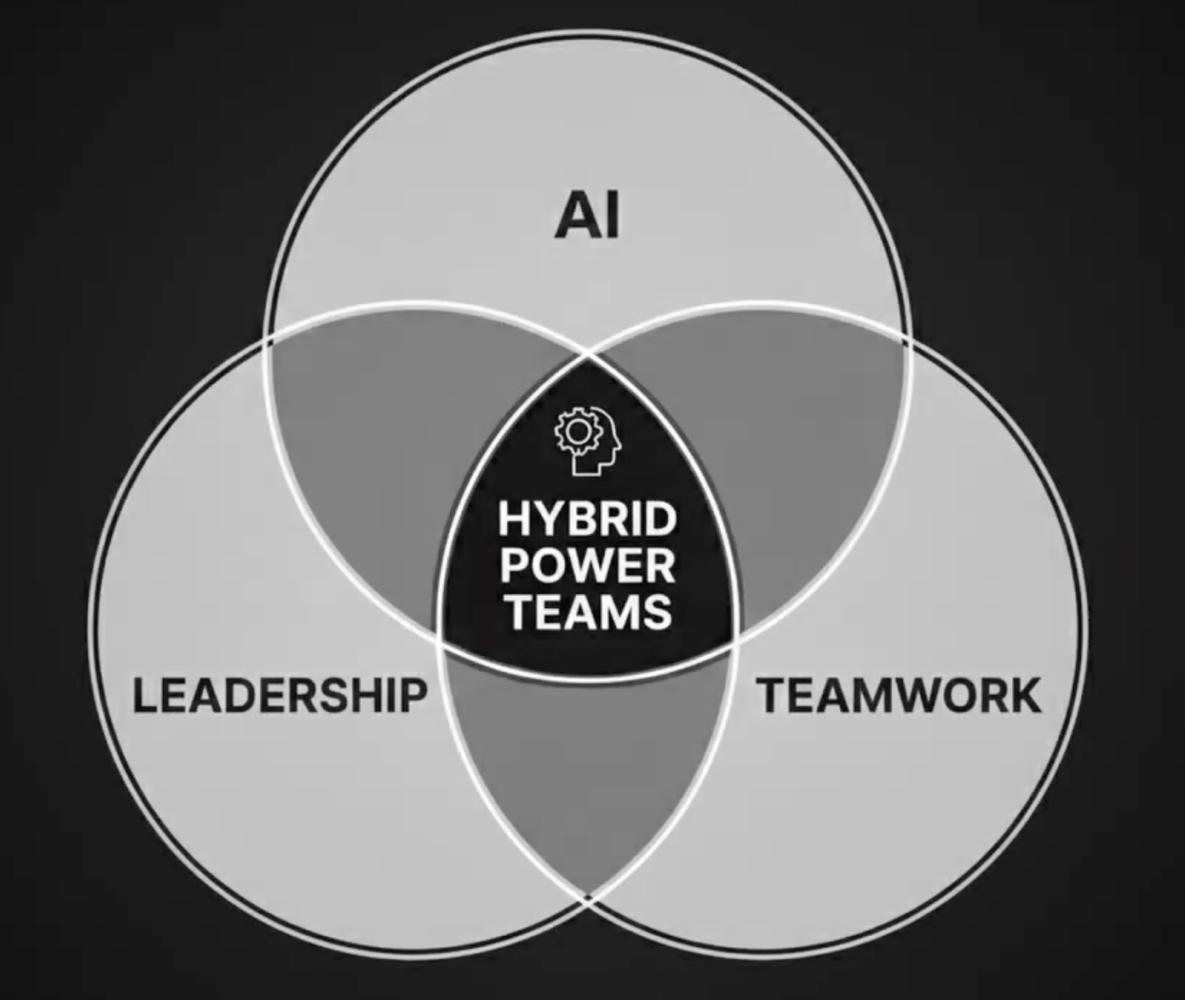
Nobody’s team gets more connected by using AI less. The future belongs to Human and AI teams. The teams that stay connected are the ones where leaders treat connection as something to design for on purpose, the same way they’d design for output or speed, instead of assuming it’ll survive on its own now that so much of the work doesn’t require another person in the room.
Don’t work in isolation just because you can. Celebrate the human connection, and build Human & AI teams!
FAQ
Does using AI at work actually make teams more isolated? It can. Gallup’s 2026 State of the Global Workplace report found leaders now report more daily loneliness than the people they manage, and a separate 2026 survey by MyIQ found 74% of employees now ask AI a question they used to ask a colleague. The tool itself isn’t the problem. Leaving the shift undesigned is.
How do you keep a hybrid or virtual team connected when everyone’s using AI differently? Make AI use a shared, visible team topic instead of a private habit. Teams that talk openly about how they’re each using AI stay more connected than teams where everyone optimizes alone.
What is the Managers of Infinite Minds concept? Peter Ivanov’s framework for a leadership reality most managers haven’t caught up to yet: they’re now managing not just their people, but each person’s AI collaborators too, and the team’s real connectedness depends on making that visible.
Do more meetings fix AI-driven team isolation? No. The fix is redesigning the rituals a team already has so they build in real connection, not adding more meetings on top of a schedule that’s already full.